
Dugo Tessari mill
In Val Liona, as in other areas of the Berici Hills, the mills made their historical appearance starting from the 13th century, following the development of agriculture, favored by the introduction of the plow and by land reclamation first by the Benedictines and then by the great Venetian patrician families. The progressive increase in the production of cereals determined the need to process them to reduce them into flour.
Thus, the mill spread, one of the most complex machines of the time, which had the advantage of using energy, hydraulic energy, which cost nothing. In the Middle Ages the right to build mills and grind grain belonged to the Bishop or local lord, and the Venetian Republic retained the right to regulate the use of water, for which millers had to present a "petition" to be "invested" of water, to be able to use it for your mill.
Over the centuries the sources of the Berici Hills were appropriately channeled and numerous mills were built along the canals. At the end of 1700, 63 were registered, of which 16 in Val Liona, an area favored by the slow flow of the waters of the "Liona" drain.
The mills were built where the water flow could be exploited.
Through ingenious wooden channels the water was brought above the wheel and made to fall into the boxes placed on the crown: the weight of the water in the "cups" imparted motion to the wheel and to the entire machine ("coppedello" mill). On the plains, instead of boxes, the wheel had curved blades that were pushed by the water current.
The valley's mills, cited in various documents from the 13th and early 14th centuries preserved in the Diocesan Historical Archives of Vicenza and recorded in notarial deeds from 1500 onwards, were either managed directly or leased. In the latter case, the value of the building and individual pieces of mill machinery was assessed.
The milling activity in Val Liona maintained a certain importance until the last war, when a dozen mill wheels were still turning; but with the spread of electricity and means of transport, accompanied by the decline in cereal production and changed eating habits, the activity definitively migrated to the plains, concentrated in industrial mills.
In the Pederiva area they survived until a few decades ago Mill de Bicio to the Waters, the Piombino mill in via Gianesin and the Pumpkin Mill in via Casamento: the only one currently still active is the Dugo Mill Tessari, in via Gianesin.
The Dugo mill has two stone millstones atop a wooden frame: the lower one remains fixed, while the upper one, toothed, rotates. It is completed by a series of auxiliary machinery and tools, such as the "tongs" for lifting the millstones, allowing the teeth to be carved. The mechanisms under the frame are now made of iron, like the large external wheel, but in the past, until around 1930, they were made of wood, having been rebuilt and repaired hundreds of times since. 1200The mill, however, still retains the structure and functionality of 800 years ago.
When the mill is in operation you cannot help but be fascinated by the background music, that is, that prolonged, subdued but at the same time intense sound that comes from the flowing water, the moving blades of the wheel, the creaking of the mechanisms, from the grain that falls grain after grain into the mill and from the rubbing between the two stone mill wheels.
The Mill belongs to the Tessari family: in particular, Mario Tessari, known as "Mario Menin," (b. 1914 – d. 1991), one of the last "munari" of the Berici Hills, is remembered, a man who dedicated nearly seventy years to this ancient craft. We know that he began this work at just eight years old, then shared the mill for decades with his brothers Antonio and Cesare. The three worked all day and at times even at night. Throughout his life, Mario traveled extensively throughout the Liona Valley in a donkey-drawn cart, transporting corn purchased from local farmers to the mill, along with flour, which he then sold to numerous families and trattorias in the valley.
For decades the mill has been visited by school groups, including those from outside the province, and by tourists who come to Val Liona at the weekend to visit it.
After the passing of Mario Tessari, his son Roberto and his grandson Diego still keep this ancient mill active today.
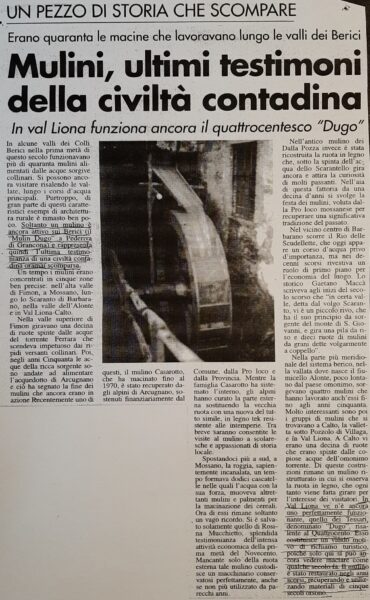
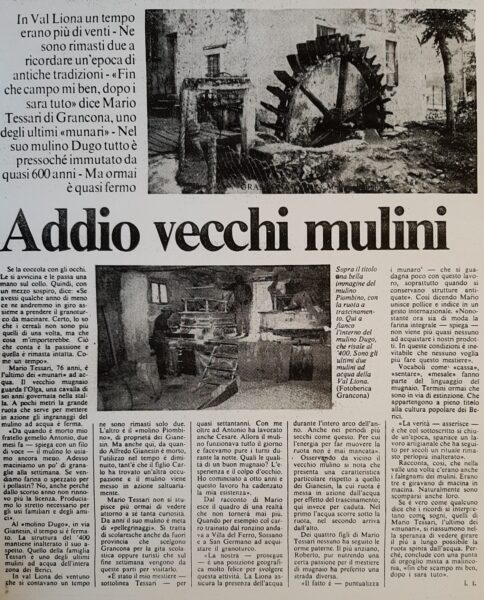
Below are a couple of articles published in Il Giornale di Vicenza in the 80s.
Images


