The Villa del Ferro reservoir
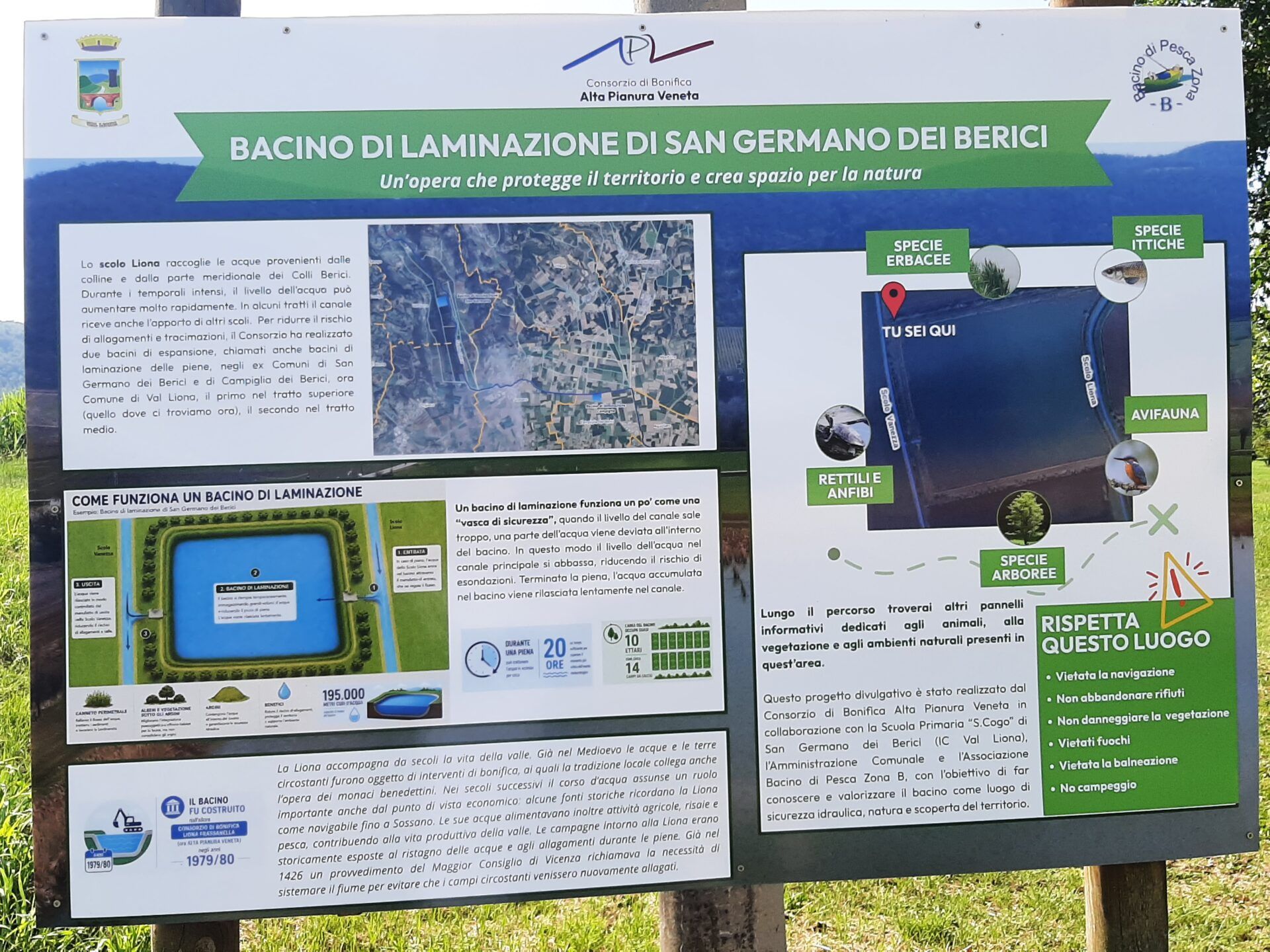
In Val Liona, on the road that connects the historic center of Villa del Ferro to the village of Campolongo, there is a small artificial lake, called the “San Germano basin” or “Villa del Ferro lake”.
This is a reservoir created in the late 70s to contain the flooding of the Liona drainage and at the same time to provide water for irrigating fields in times of drought.
Over time, it has become a site of notable naturalistic importance due to the presence of both a large surface area of permanent water and, above all, a significant perimeter strip of marsh vegetation.
The reed bed, which has grown over time within the lake basin, constitutes an extremely rare habitat both in the Berici Hills (where Lake Fimon has unfortunately lost much of its ecological value as a wetland due to the extreme reduction of the typical marsh vegetation that characterised it until a few years ago), and in the entire province of Vicenza.
During spring and autumn, as well as in winter, the basin is visited by a very large number of amphibian and bird species, the latter being migratory and/or wintering respectively, some of which are quite rare in the province of Vicenza. These include the Osprey, the Hen Harrier, the Little Black Tern, the Greater Flamingo, and the European Roller, which nests in the Liona Valley itself, not far from the basin, one of the very few known breeding sites in the entire Vicenza area.
It is interesting to note that the Department of Biology of the University of Padua between 2014 and 2021 carried out a study on the migration methods of the breeding population of Great Reed Warbler, a bird that nests primarily in the reed beds of the Villa del Ferro basin and migrates approximately 5.000 km in autumn to West Africa, crossing the entire Italian peninsula, the Mediterranean, Tunisia/Algeria, and the Sahara Desert, before reaching the Ivory Coast, before returning to the basin in spring (see map below). The results were presented during a zoological conference entitled "VicenzaFauna2021" on November 26, 2021, at the Museo Naturalistico Archeologico in Vicenza (click here To download the extract of the proceedings that talks about the above-mentioned study – click here to download the entire conference proceedings document).
Spending a few hours around the basin, you can see how the reed beds are home to very large populations of other species associated with these habitats, which have now become rare both in the Berico area and in the entire Vicenza area: in particular the Little Bittern, the Coot and, last but not least, the Kingfisher.
The most common species present throughout the year are the Cattle Egret, the Common Reed Warbler and the Swallow.
The basin, frequented by fishermen from Tuscany, Emilia, and Lombardy, has become a famous "hot spot" thanks to the quantity and variety of fish present, including pike, largemouth bass, carp, tench, and eel, as well as the more common small species.
In the many reviews on various fishing sites, the basin is recognized as a fishing spot, quiet, scenically beautiful and above all safe.
The perimeter, approximately 1 km long, consists of safe and well-maintained embankments, accessible on foot or by bicycle; a little caution is required only on the eastern side, where the basin borders the Liona River.
Fishing from a boat is prohibited in the basin, while the use of belly boats is permitted.
The site is managed by the “BACINO PESCA ZONA B” Association (a free association of amateur and sports fishermen based in Vicenza), under a concession for amateur sport fishing and environmental protection.
For info: Waters under concession – Fishing Basin B Vicenza

Text written in collaboration with Giovanni Zanella, councilor of the Bacino Pesca B Association
Images